Know where AI earns its capital.
Where your operation is ready, which AI opportunity returns fastest, and what the first 90 days look like.
$99$9 USD — Every insight your leadership team needs before the first AI decision, in less than 9 mins.
Where your operation is ready, which AI opportunity returns fastest, and what the first 90 days look like.
$99$9 USD — Every insight your leadership team needs before the first AI decision, in less than 9 mins.
Your three best AI opportunities, ranked by return window and effort, with projected impact you can run against your own costs.
$99$9 USD — Every insight your leadership team needs before the first AI decision, in less than 9 mins.
Where your operation is ready, which project to fund first, and how you compare with peers.
$99$9 USD — Every insight your leadership team needs before the first AI decision, in less than 9 mins.
Ranked insights on impact, effort and return window, so the business case is built before the budget moves.
$99$9 USD — Every insight your leadership team needs before the first AI decision, in less than 9 mins.
Readiness insights across five areas, your top three AI opportunities ranked, and a 90-day plan for the first one.
$99$9 USD — Every insight your leadership team needs before the first AI decision, in less than 9 mins.
9 minutes in. $2.4M identified.
An [Ohio] [pump]manufacturer, [3]plants. First pilot: vendor invoice reconciliation.
Budget enters the conversation before readiness, value and ownership have been tested. That sequence, not the technology, turns AI investment into a sunk cost. 98% of manufacturers are exploring AI. Only 20% are ready to deploy at scale.
Headline use cases get chased before anyone tests whether the data and the workflow can support them.
Where they stall, the causes are data quality (51%), integration (43%) and unclear ROI (30%). Model performance rarely appears.
Without a cost baseline for the target workflow, no one can say afterwards whether the pilot actually paid.
CEO, finance, manufacturing excellence and plant operations each judge the same proposal against a different standard.
This is the gap Signal AI closes: one assessment, one score, three ranked opportunities. So the first AI decision is made on evidence, not on who argues it best.
Sources: Redwood, Manufacturing AI and Automation Outlook 2026; RSM, causes of stalled AI pilots.
Gowitek’s leadership on what manufacturers get wrong before their first AI investment, and the decision this assessment is meant to settle.
Your workflows, data maturity, systems and priorities, in under nine minutes.
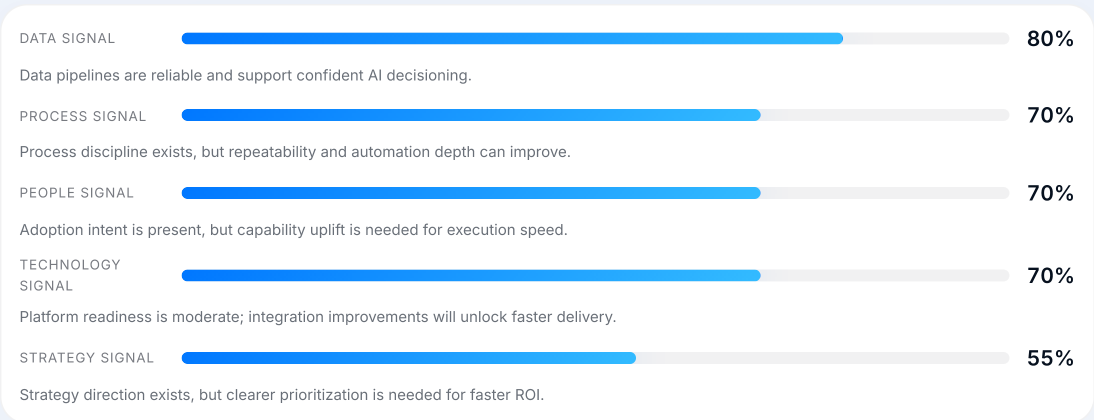
Data, process, people, technology and strategy, each scored and interpreted.
Three opportunities compared on impact, effort and ROI window, with one recommended first.
Four phases, week by week, from validation to measured value.
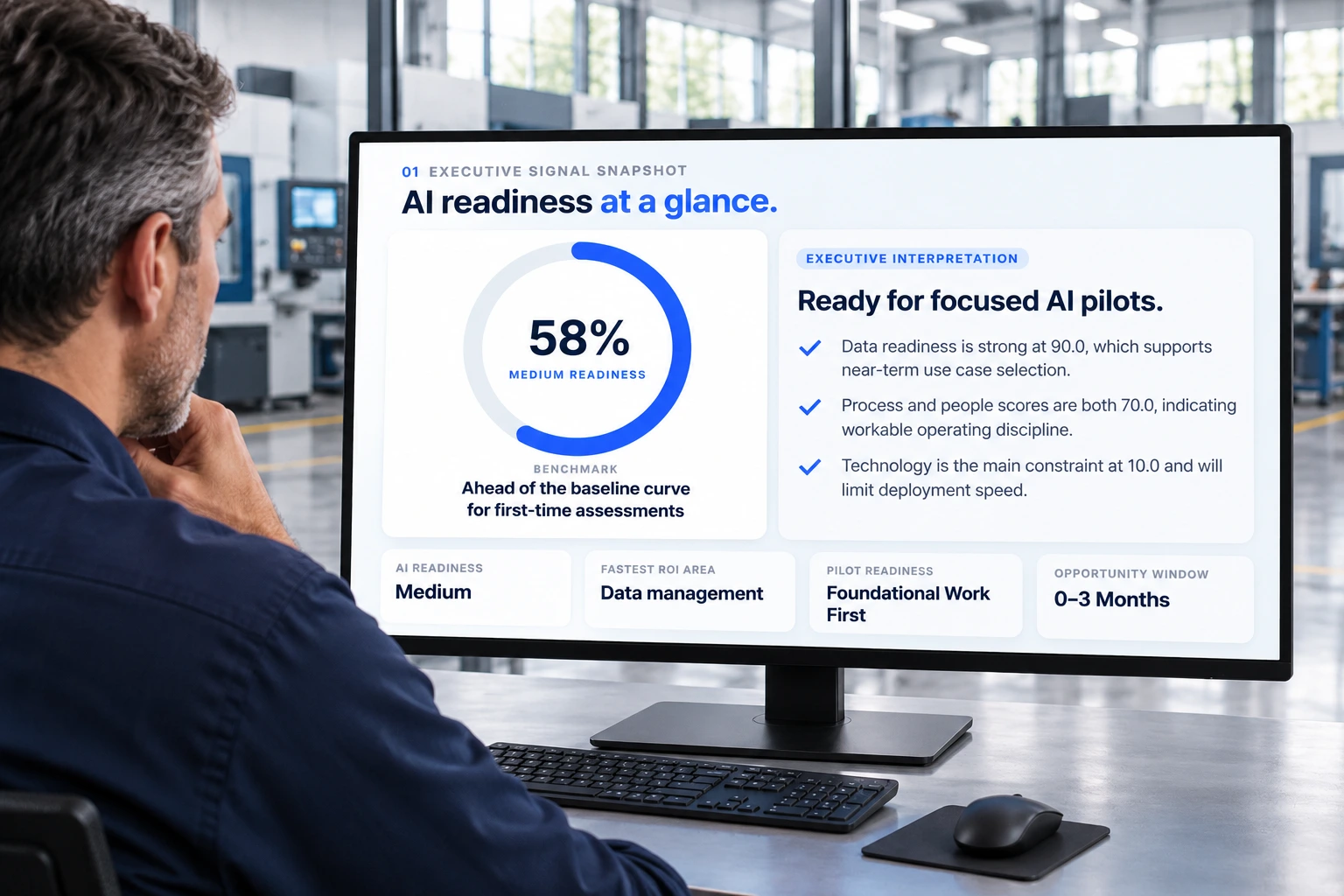
Readiness score, peer benchmark, prioritization matrix, ROI window and a 90-day plan, so every leader works from the same view.
It ends the "are we ready?" debate. The overall score shows where you stand, and the five pillar scores show exactly which one is holding you back, so you fix the real constraint instead of guessing.
Boards don't ask "are we ready?" They ask "are we behind?" The benchmark and maturity stage answer that directly, and show what the next stage looks like, so AI becomes a board decision rather than an IT experiment.
Every opportunity is plotted by impact and ease of deployment. The first pilot is picked because it sits in the quick-win zone, not because it had the loudest sponsor, and that rationale is what gets it through the budget meeting.
Each opportunity comes with an ROI window, its complexity and a confidence signal. Finance can fund what returns inside the budget year, and apply the projected impact to its own numbers to build the business case.
The plan breaks the first pilot into four phases with clear week ranges, starting with a steering committee in week one. Operations knows what's coming, and leadership can track progress against a structure instead of a promise.
From board priorities to plant execution, each leader gets a clearer view of the decision they own.
“70% AI readiness, but strategy at 55%. The report gave me a clearer board conversation: where we stood, what needed attention, and which pilot to back first.”
“A 2–4 month ROI window for the recommended pilot gave me something concrete to evaluate. I could weigh the expected return against implementation effort before committing capital.”
“One recommended pilot. A 12-week plan, phase by phase. The report gave us a starting point: validate the opportunity, align the workflow, build the pilot, and measure its value.”
“The report gave me a first pilot to evaluate against our downtime priorities, flagged the data and workflow gaps, and laid out the first 90 days. I could see what needed fixing before bringing the pilot onto the floor.”
Explore how readiness and business priorities shape the recommendation, from approving a pilot to fixing the foundations first.

Service and warranty requests took 3 days to resolve. Leadership couldn’t agree where AI should start.

Demand swings drove excess inventory and rush production. The CFO needed a return within the budget year.

The board wanted an AI pilot this year. Each plant ran its own systems, and no one trusted the numbers across sites.
How Signal AI compares
Compare the depth of the assessment, the report outputs and the commitment required.
Where you stand, which AI opportunity deserves attention, and what has to happen before you invest - in under 9 minutes, for $9.
Compare the depth of the assessment, the report outputs and the commitment required.
Where you stand, which AI opportunity deserves attention, and what has to happen before you invest - in under 9 minutes, for $9.
The questions manufacturing leaders ask before committing budget to AI.
Most AI pilots fail for operational reasons, not technical ones. The common causes are data quality (51%), integration difficulty (43%) and unclear ROI (30%); model performance rarely appears on the list. Pilots stall because budget was committed before anyone tested whether the data, the workflow and the business case could support it.
The return depends on the workflow you target rather than on AI itself. Signal AI expresses projected impact as a percentage improvement on a single metric — for example 30% less unplanned downtime or a 20% efficiency gain — which you apply to your own cost baseline for that workflow. That is the only way to size the return defensibly before a pilot runs.
Start with one workflow that is high-volume, repeatable, already measured and running on data you already collect. In practice that is usually invoice or order reconciliation, service and warranty triage, demand forecasting or quality inspection — not a plant-wide programme. The first decision is which workflow, and the evidence for it is readiness across data, process, people, technology and strategy.
Probably less than it feels. 98% of manufacturers are exploring AI, but only about one in five consider themselves ready to deploy at scale, so most of the sector is still evaluating. Being behind has less to do with whether you have started than with whether you have picked a workflow where the data already supports a return.
You need structured data in one workflow, not clean data across the business. A first pilot needs inputs that are captured consistently, a process that runs the same way each time, and a cost baseline to measure against. Waiting for enterprise-wide data quality is the most common reason manufacturers never start.
A defensible AI business case needs four things: a named workflow, the current cost baseline for it, an expected percentage improvement and a return window in months. Without the baseline there is nothing to check the projection against. Signal AI supplies the ranked opportunities and ROI windows so finance can apply them to its own numbers.
No. Most first pilots run alongside existing systems, using data those systems already produce. What matters is whether the data can be extracted and whether the workflow is stable, which is what the technology pillar of a readiness assessment scores. Replacing core systems is a separate decision with its own business case.
In most cases, yes. A first pilot in a well-chosen workflow needs an operational owner who understands the process, someone who can get at the data, and a team to build it — not a data science function. Whether your team has the capacity is scored in the people pillar, and it is the constraint most often underestimated.
Payback depends on the workflow. Low-complexity pilots in high-volume manual work typically carry a two to four month return window, while medium-complexity work such as forecasting or planning usually runs four to six months. Signal AI states a return window for each of the three opportunities it ranks, so they can be compared before one is funded.
It depends on what you still have to decide. If you do not yet know which workflow to target, a consulting discovery engagement costs tens of thousands of dollars and takes weeks to answer a question a structured assessment answers in minutes. Once the workflow is chosen and has to be built and integrated, that is where external help earns its fee.
The practical risks are rarely dramatic: committing budget before the data is validated, choosing a workflow nobody owns, running a pilot with no agreed success measure, and losing momentum when the sponsor changes. Signal AI names the strategic risks alongside the recommended pilot so they are managed rather than discovered.
A first pilot is usually scoped to 90 days across four phases: validate the opportunity and the data in weeks 1–2, align the workflow and owners in weeks 3–4, build and test in weeks 5–8, and measure against the baseline in weeks 9–12. Longer pilots tend to lose executive attention before they produce a measurable result.
Know which AI opportunity deserves a closer look, what could hold it back, and where to start. Give your leadership team a practical basis for deciding what to fund and what to fix first.

We use cookies to improve your experience on our site. By using our site, you consent to cookies.
Manage your cookie preferences below:
Essential cookies enable basic functions and are necessary for the proper function of the website.