
Field notes · OEM leadership
Nobody Asked Us for More AI. Here's What OEM Leaders Asked Instead.
By John Mathew and Rahul Khode, Co-founders, Gowitek · 9 min read
A technician flies out to a customer's site to fix a machine that's down. He replaces a part. The fault comes back. He flies out again. Back at headquarters, a manager who should be planning next year's growth spends the afternoon on the phone, talking him through it.
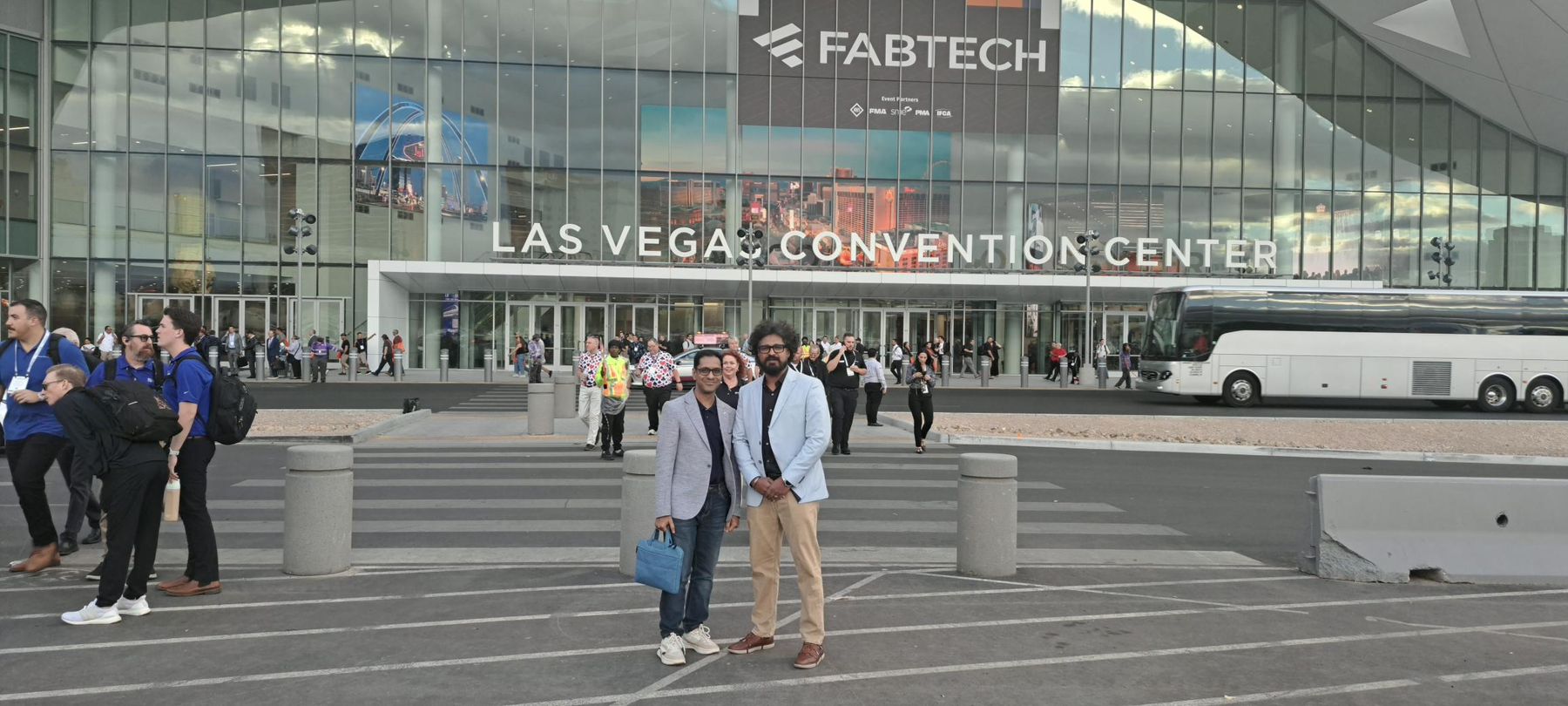
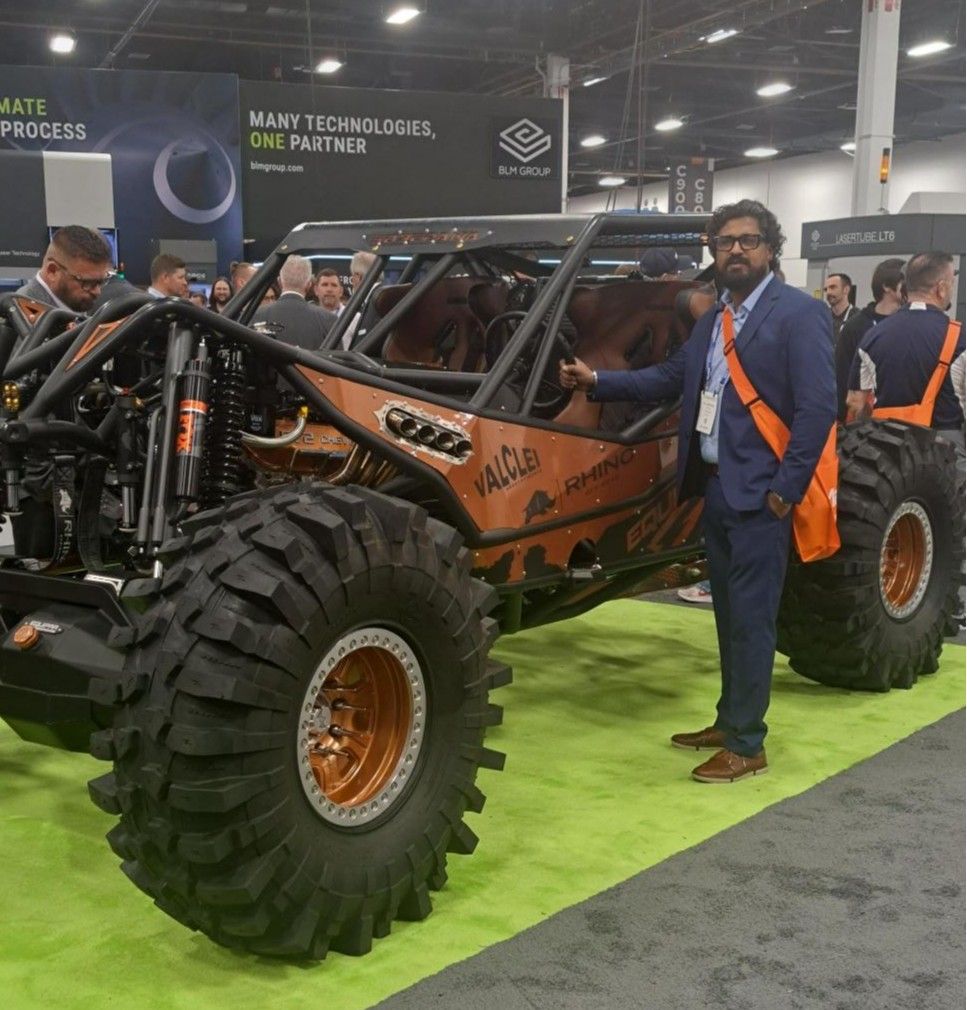
We heard some version of that story more than once this fall, as the two of us traveled across Texas, North Carolina, Pennsylvania, Minnesota and California to sit down with the people who run America's equipment makers. Press brakes and punching machines. Saws and cutting systems. Structural steel lines, material handling, woodworking and water technology. Some conversations happened in conference rooms. Many happened on shop floors and over dinner. We finished the trip at FABTECH in Las Vegas.
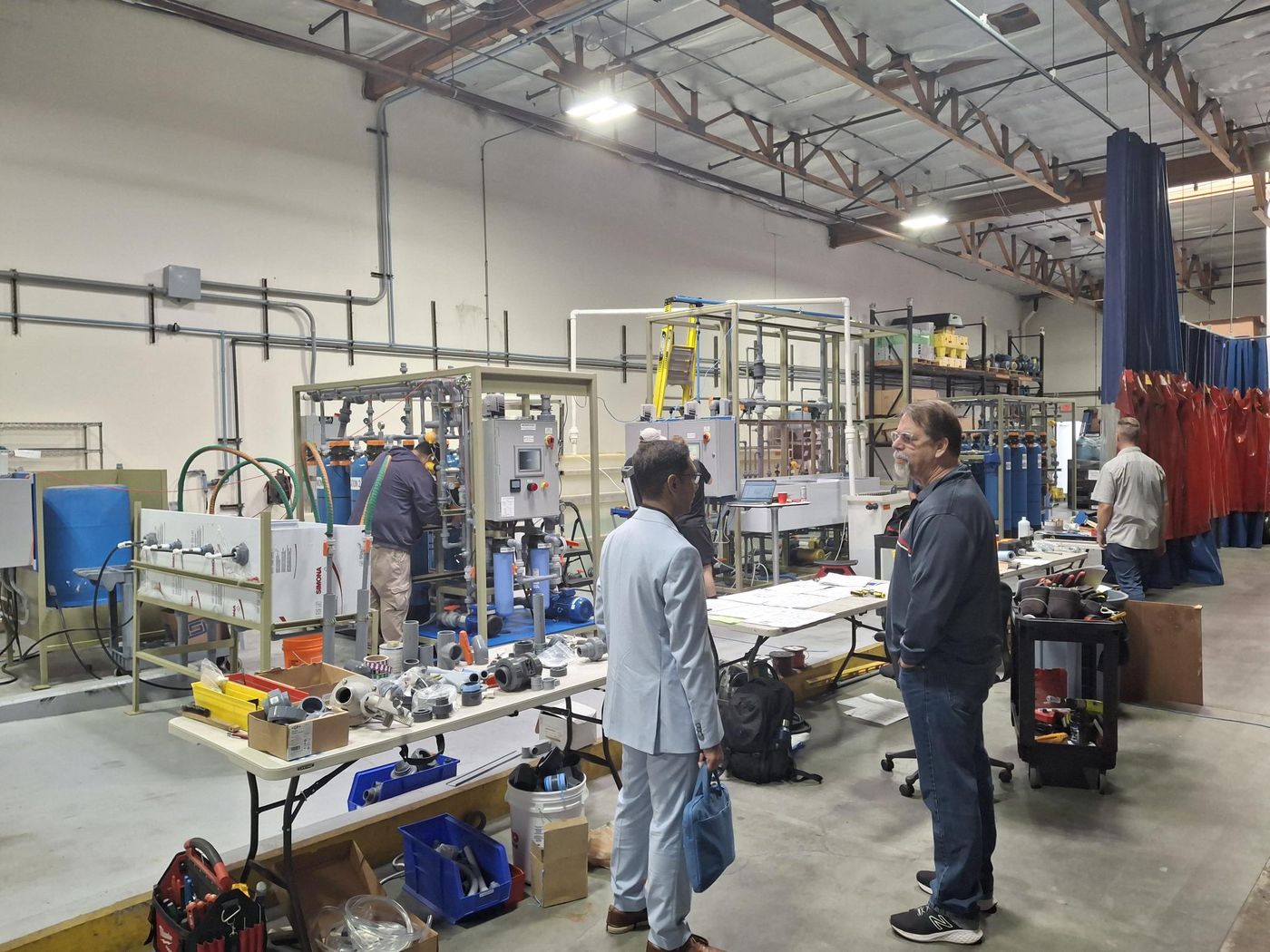
We went expecting to talk about AI. Almost nobody wanted to. What they wanted to know was simpler, and harder: where is my business leaking money, and can anyone actually help me stop it?
After weeks of listening, we think the answer comes down to one uncomfortable idea. The machines these companies build have never been smarter. The business wrapped around them has barely changed. The quote desk, the engineering bench, the parts counter and the service team still run on email, spreadsheets and the memory of a few people who have been there twenty years. That gap is where the money goes.
Here are the seven places we saw it most clearly.
This was the clearest message from our conversations. Most leaders we met have sat through the demos and paid for pilots. Many of those pilots worked technically, then were abandoned because they never reached the P&L.
“Where is the ROI?”
Why don't working pilots reach the P&L? The reasons have little to do with the AI itself. The wrong use cases get funded: pilots are picked for an impressive demo, not for the decision that costs the business most. The right people aren't in the room: a quoting decision touches sales, engineering, purchasing and production, yet the pilot sits with IT. And the value is never defined up front, so there is nothing to prove at the end. Most pilots are measured at the output and abandoned before they reach the financial result.
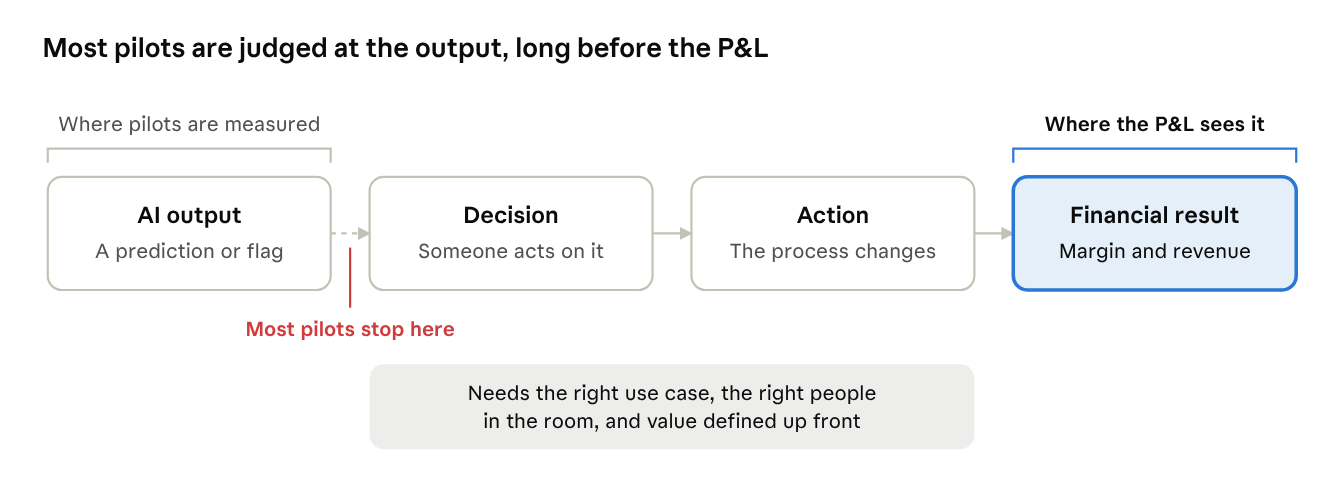
The fix starts before the pilot does. Prioritize the decisions that cost the most, bring every function that touches them into the room, and make a business leader accountable for the number. Then ROI becomes something you can measure.
Every company we visited was sitting on more information than it uses. Machines log faults. ERP holds orders and costs. Engineering knows how each configuration behaves. Service knows what breaks, and why.
At a material handling OEM, we asked the owner and plant manager to walk us through a decision they make every week: a customer asks for a delivery date on a configured system. How do they answer? The order details sit with the sales manager, in the CRM. Shop capacity sits with the production planner, in ERP. Supplier lead times sit in the purchasing lead's inbox. And whether that configuration has caused trouble in the field sits in the service manager's head. Nobody sees all four. So the date takes days to come back, gets padded to be safe, and sometimes still slips, because the one fact that mattered was with the person nobody thought to ask.
The trouble is that each piece belongs to a different team, in a different system, and nobody owns the connection between them. So when a decision needs all four, people do what they've always done. They pull a spreadsheet together by hand and call the person who has been there longest. It works. It's also why the business moves slower than its own machines.
Try this with any OEM leader. Ask how many of their machines are still running in the field, how old they are, and which ones are due for a rebuild. Then watch them reach for the phone to call the service manager.
“Ask me how many of our machines are still running out there, and I'd have to call our service manager.”
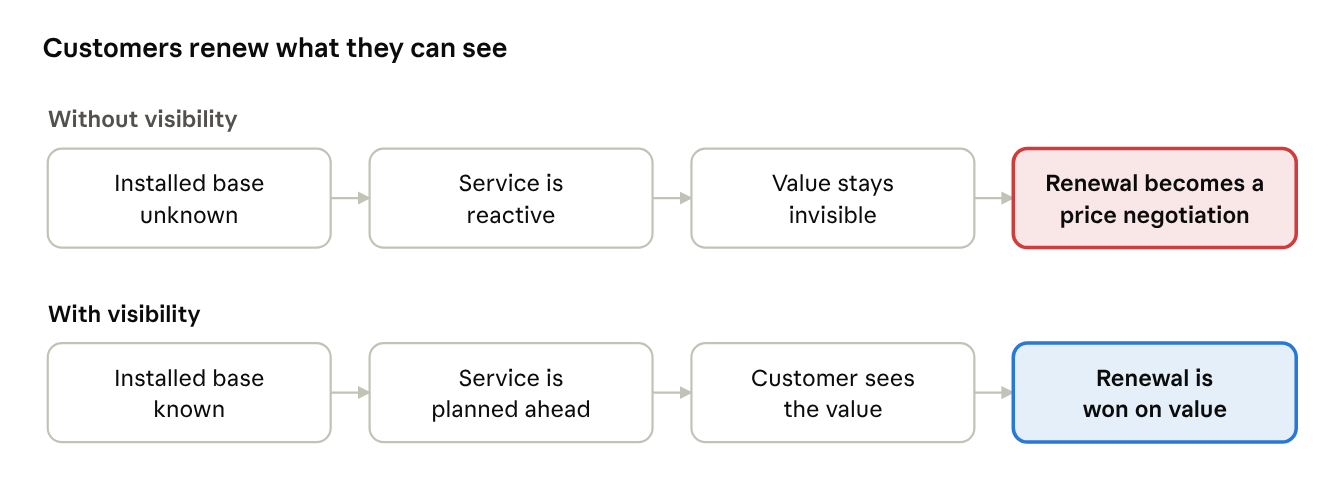
Aftermarket revenue lives on renewals: the service contract signed again, the parts reordered, the upgrade approved. That's where the margin is. Most OEMs treat growing it as a pricing question. We think it's a visibility question. A customer renews when they can see what the service did for them: the uptime protected, the failure caught early, the rebuild planned before it became urgent. An OEM that can't see its own installed base can't show the customer any of that, so every renewal turns into a negotiation on price.
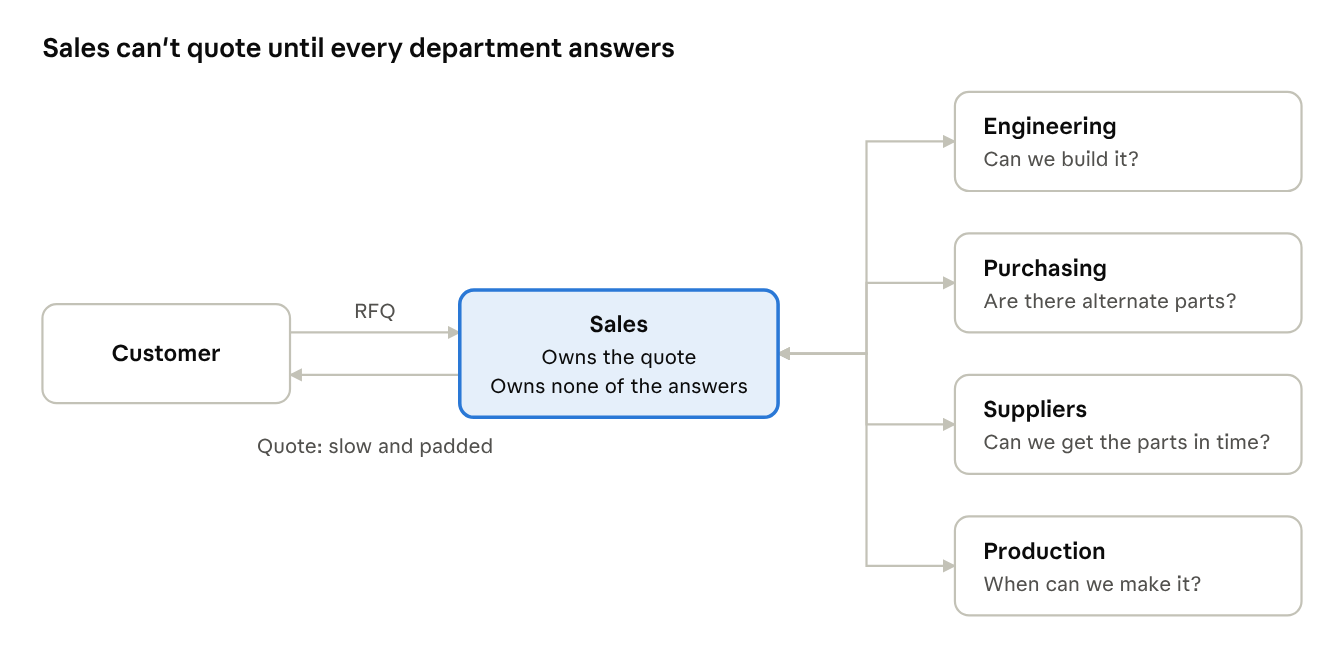
Ask how long it takes to go from a customer's RFQ to a delivery date the company can stand behind, and the answers we heard were rarely about the factory. Before a date can be promised, engineering has to validate the design, someone has to check alternate components, suppliers have to confirm, and production has to review capacity.
Across the plants we walked through, and again in the FABTECH halls, the progress in automation, cutting systems and production equipment was hard to miss. Machines today sense, adjust and report on their own health in ways they couldn't a few years ago.
But a smarter machine doesn't fix what sits around it. An ERP record can still disagree with the engineering drawing. Inventory can still miss the parts the last service visit used. Service histories live in a separate system, or in no system at all. Many OEMs invest in the machine layer and assume the operational layer will follow. It doesn't. Those layers have to be connected on purpose, and that work is slower, harder and far less visible than buying new equipment.
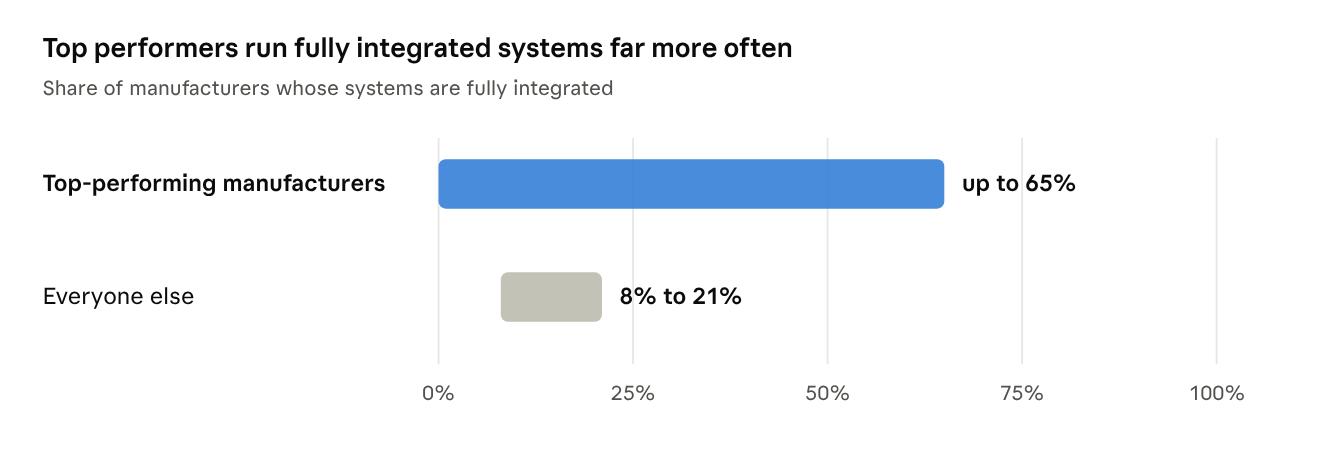
For OEMs, the next advantage won't come from the next machine. It will come from connecting the operations around it.
John heard this one in plain words. Experienced technicians are retiring faster than skilled replacements arrive. The newer ones often can't solve a difficult problem at the customer's site, so a second visit follows. When that doesn't work either, the issue climbs to mid-management, and managers spend their days troubleshooting instead of working on strategy, customers and growth.
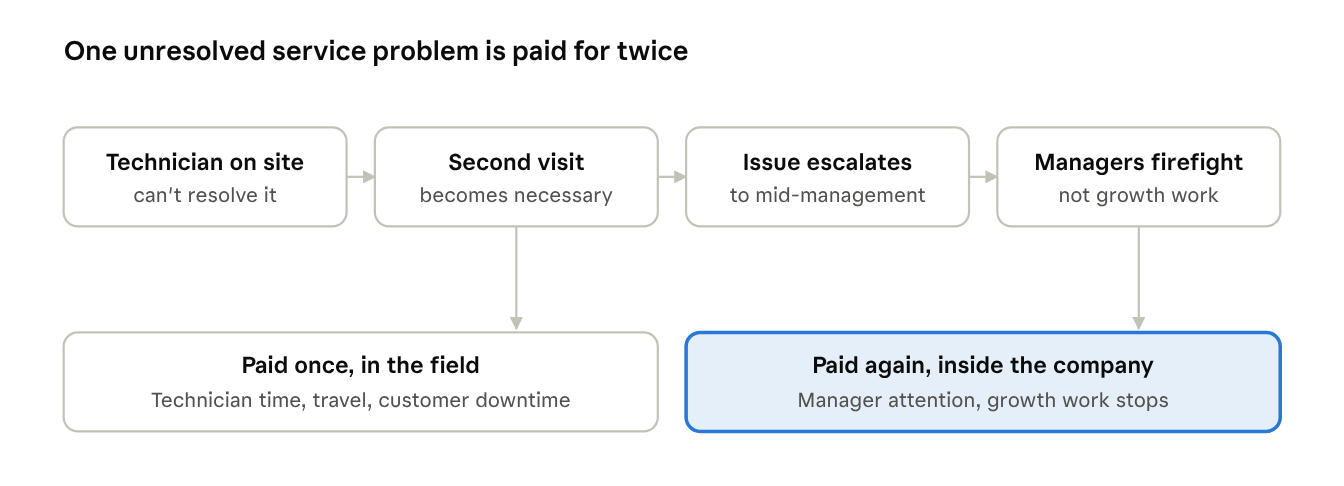
So a single unresolved problem is paid for twice. Once in the field, in travel, labor and the customer's downtime. And again inside the company, in the attention of the people who should be building the business. Service reports track the first cost. The second rarely gets tracked at all.
“Some days my best managers are basically a help desk for the field.”
At FABTECH, adaptive robotic welding drew a crowd. In our conversations afterward, the OEMs who sell into job shops kept returning to one question: does automation still pay back when no two orders look alike?
Most automation economics were built for repetition: the same part, thousands of times, with the setup cost spread thin. A job shop works the other way. Frequent changeovers, custom specifications and batch sizes that can drop to one mean a robot can spend more time being set up and programmed than running. The cell gets bought for its cycle time. It gets judged on its idle time. So the bottleneck moves from the welder to the programmer, and the payback stretches with every new order.
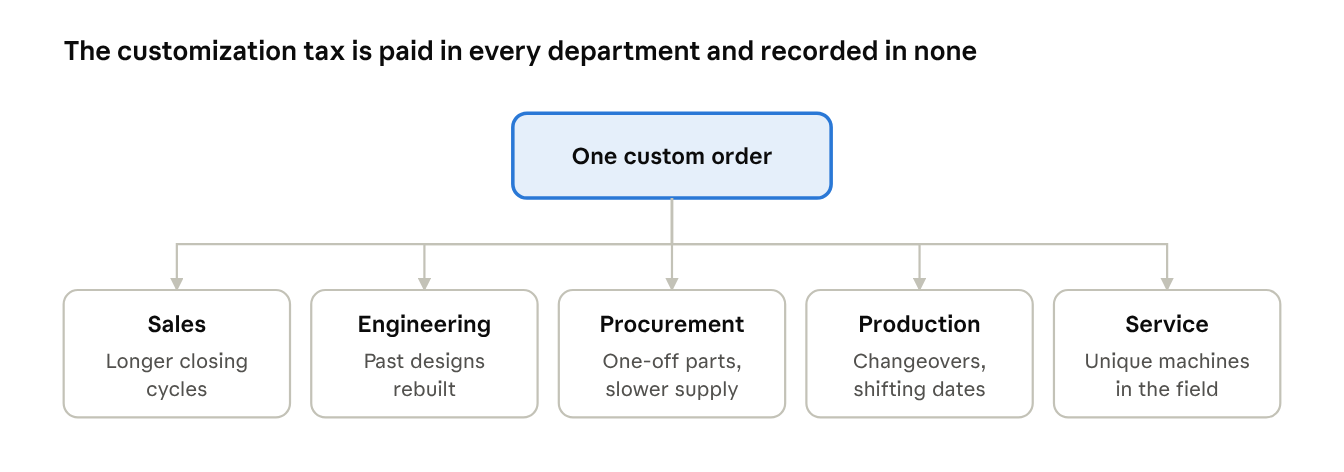
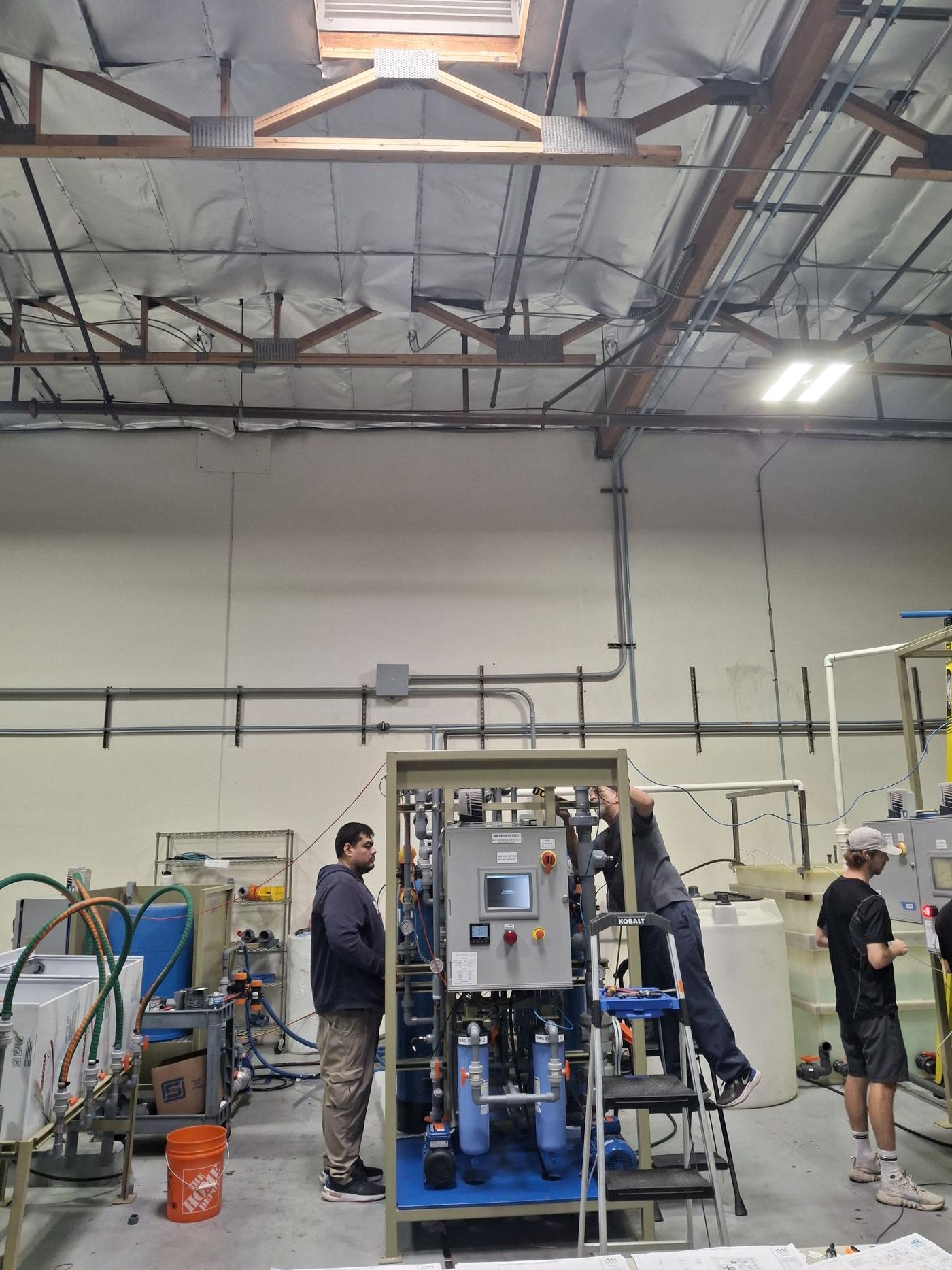
The same tension shows up before an order is even won. A water technology OEM we met designs a personalized solution for every customer, so every bid starts from zero and the closing cycle runs long. Rahul's view is that it shouldn't. The core of the work doesn't change: it's still water technology, built on the same engineering logic. That logic may not fit a traditional software solution, but it can be written as agile business rules that AI understands. His estimate: 50 to 60% of the bidding work could be automated, with the remaining 40% handled by people in the loop. A faster bid means a shorter road to closing the deal.
“Every custom quote feels like we're starting from scratch, even when we've built something almost the same before.”
What we brought home
Read together, these aren't seven problems. They're one problem showing up in seven places: smart machines running inside businesses that can't yet keep up with them. And because the gap sits between departments, no single department owns fixing it.
That's why we think the next two years will look different from the last two. Speed of commitment, not machine specs, will decide more custom deals. AI budgets will shift from shop-floor experiments to the quote desk, engineering and service, where the payback can actually be measured. And “what happens if our two most experienced engineers leave?” will move from an HR question to a board question.
Five questions worth taking to your team this week
If the answers are fuzzy, you've found your first real AI opportunity. It just isn't the one on the vendor slides.
We learned more from these conversations than from any report we read this year, and we're grateful to every leader who made the time. If you saw your own business in any of this, we'd like to compare notes. You can reach either of us directly.
John Mathew and Rahul Khode are co-founders of Gowitek, which works with OEM manufacturers on the decisions that sit between quoting, engineering, service and the aftermarket.