Your service data already holds the warning signs. It's just scattered across too many systems for anyone to see them.
Gowitek · 4 min read
Eighteen months ago, a bearing failed on one of your machines at a customer in Ohio. Your tech replaced it and closed the ticket.
Nine months later, the same bearing failed at a customer in Texas. A different tech handled it, and it was logged as a warranty claim in a different system.
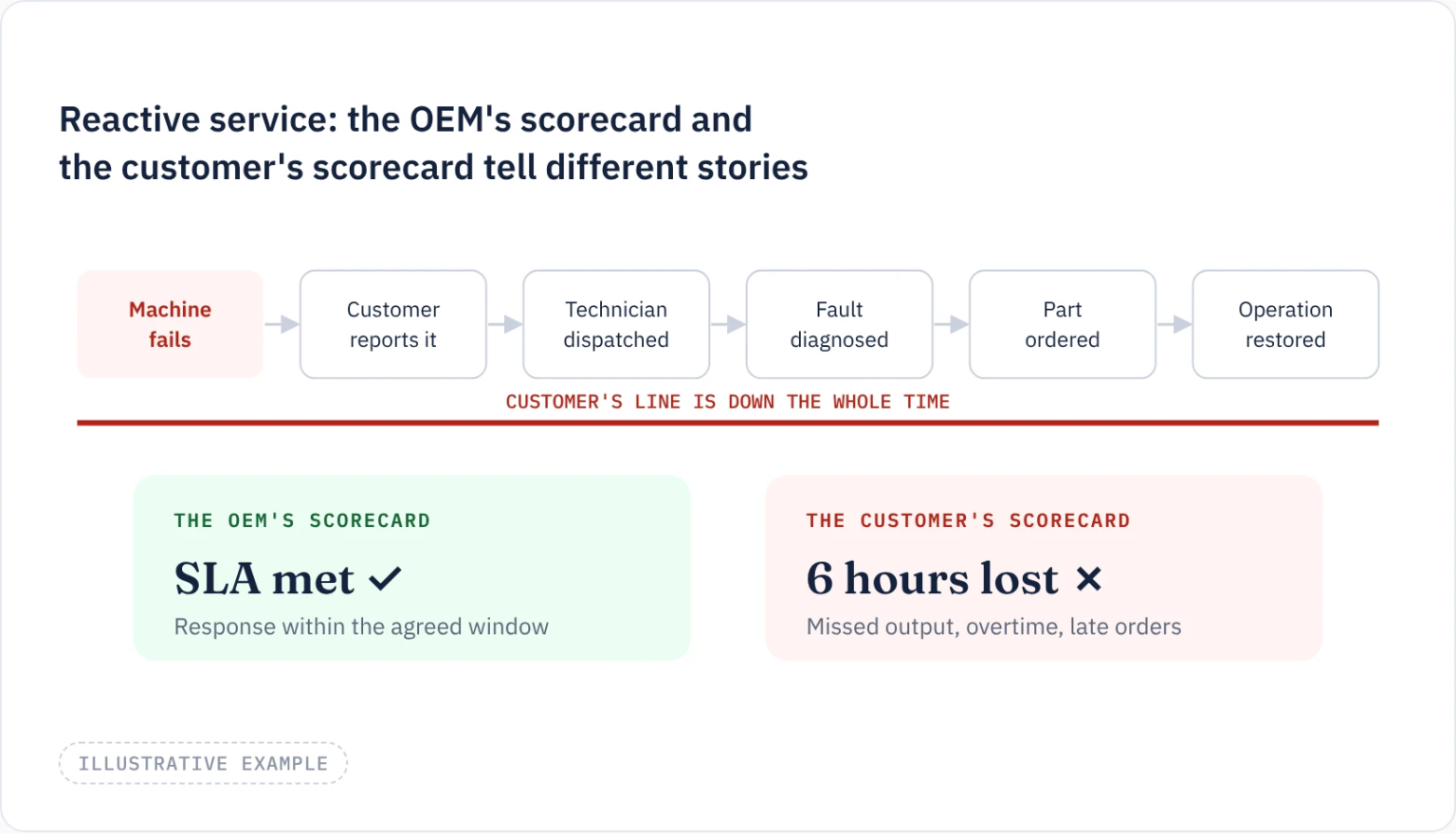
This month, it failed again in Georgia. This time, the customer's line was down for two days.
Three failures. Three closed tickets. Nobody connected them.
The same failure, seen two ways
Siloed
18 months ago
Site A
Ticket closed
9 months ago
Site B
Warranty claim
Now
Site C
Line down 2 days
Connected
18 months ago
Site A
Failure logged
9 months ago
Site B
Pattern flagged
Now
Site C
Fixed in a planned window
Now ask your team a simple question: which failures keep repeating across our installed base? For most OEMs, the honest answer takes weeks, three spreadsheets and a lot of phone calls. Sometimes there is no answer at all.
The data was never the problem
You already collect what you need to spot that bearing. Every visit, claim and report is recorded somewhere. The problem is where.
This is more common than most leaders think. In a 2026 survey of 511 US manufacturing professionals, Hexagon found that 77 percent describe their operations as connected, but only 40 percent have data connected across systems. Two in three have no single view of data from most of their systems.
The gap is widest at the top. Hexagon found 80 percent of executives believe their data is integrated, while only about a third of shop-floor workers agree. If you think your data is connected, check with the people who use it.
What silos cost you
Scattered data doesn't just slow reporting. It blocks the things a service business runs on.
What you can do with siloed data versus connected data
What you need
With silos
Connected
Spot repeat failures
Every failure looks like a one-off
The pattern shows by the second occurrence
Prevent downtime
You learn from the customer's angry call
The fix is planned before the failure
Prove value
Good work nobody outside service sees
Avoided downtime in the customer's own numbers
Price service contracts
Guesswork
Real failure history across the fleet
Your customers feel the cost first. Unplanned downtime costs the world's 500 largest companies about 11 percent of revenue. Then you feel it, in emergency call-outs, warranty costs and customers who remember every breakdown when they buy their next machine.
Why nobody fixed this before
Not for lack of trying. Connecting these records meant reconciling data that shares no common structure: a clean log from one plant, a free-text note from another, a scanned PDF from a regional office. That used to mean years of IT projects or replacing systems outright.
PwC reaches the same conclusion: for most manufacturers, the obstacle isn't a lack of connectivity, it's the fragmentation left by every system that came before. New sensors don't fix that on their own.
What has changed is AI. Today's models can read structured logs, technician notes and reports together, and reason across them as one fleet. Deloitte points to the same shift. For the first time, you can connect your service data without ripping anything out.
You don't need more data. You need the data you already have to talk to each other.
Where ServitizeIQ fits
ServitizeIQ connects to the systems you already run and reads across your service history as one fleet:
Connect.
Maintenance logs, technician notes, warranty claims and reports, in one view.
Predict.
Repeat failures flagged early, so the third bearing is a scheduled fix, not a two-day outage.
Prove.
Avoided downtime recorded in each customer's own numbers.
It is configured, not built, so you start with one equipment line and the data you have today.
What is your service data not telling you?
In 30 minutes, we will look at where your service data lives and show you the patterns it could reveal.
Data silos are service records kept in separate systems that don't share information, such as maintenance logs, technician notes, warranty claims, PDF reports, spreadsheets and email. Each is accurate, but no one can see patterns across them.
How do data silos cost OEMs revenue?
Silos hide repeat failures, so OEMs fix the same problem again and again instead of preventing it. That leads to customer downtime, higher warranty and emergency costs, weaker proof of service value, and lost repeat business.
Do OEMs need to replace their systems to connect service data?
No. Modern AI can read structured logs, free-text technician notes and reports together, so OEMs can connect their service history without ripping out existing ERP, CRM or field service systems.
How can AI help OEMs with fragmented service data?
AI can reconcile records in different formats, spot failure patterns across customer sites, and flag issues early, turning scattered service history into predictive, planned maintenance.
Cookie Consent
We use cookies to improve your experience on our site. By using our site, you consent to cookies.