
Your SLA Was Met. So Why Is the Renewal a Price Fight?
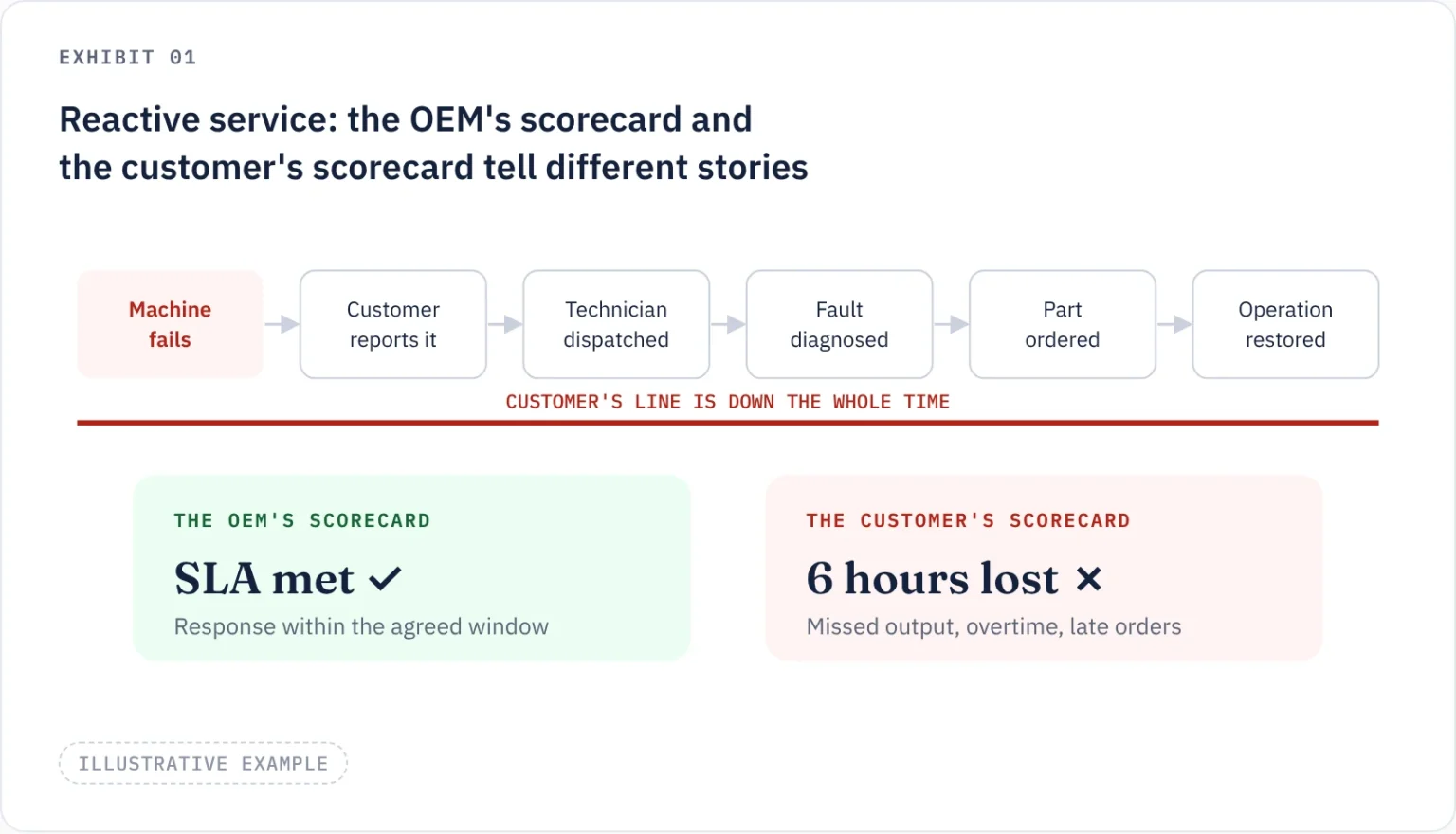
A critical machine fails in the middle of a production run. The customer reports the issue. A technician is dispatched, diagnoses the fault, orders a replacement part, and restores operation.
The service team resolves the issue within the agreed response window. Technically, the OEM met its SLA.
The customer's line was still down for most of a shift.
Nine months later, the service agreement is up for renewal. Your report shows strong SLA compliance. Procurement shows the downtime log, and asks for 15 percent off.
If your team runs scheduled maintenance instead, you may hear the opposite objection: "We barely needed service this year. Why should we pay for another contract?"
Both conversations end the same way. Here is why, and what has to change before you can renew on value instead of price.
Why do customers push back on service renewal pricing?
Because your SLA and your customer measure different things. The SLA measures your response. The customer measures their downtime: lost output, slipped orders, overtime. In reactive service, you can win on the first and still lose on the second.
And every reactive interaction starts with a failure. By renewal, the customer's memory of your service is a list of bad days, each one fixed. The contract looks like an insurance policy that never prevented anything, so price becomes the only thing left to negotiate.
You can meet every SLA and still lose the renewal. The SLA measures your response. The customer measures their downtime.
Most OEM service is still reactive
A 2025 survey of 900 field service leaders by Deloittefound most service organizations still fix equipment after it fails or service it on a fixed calendar.
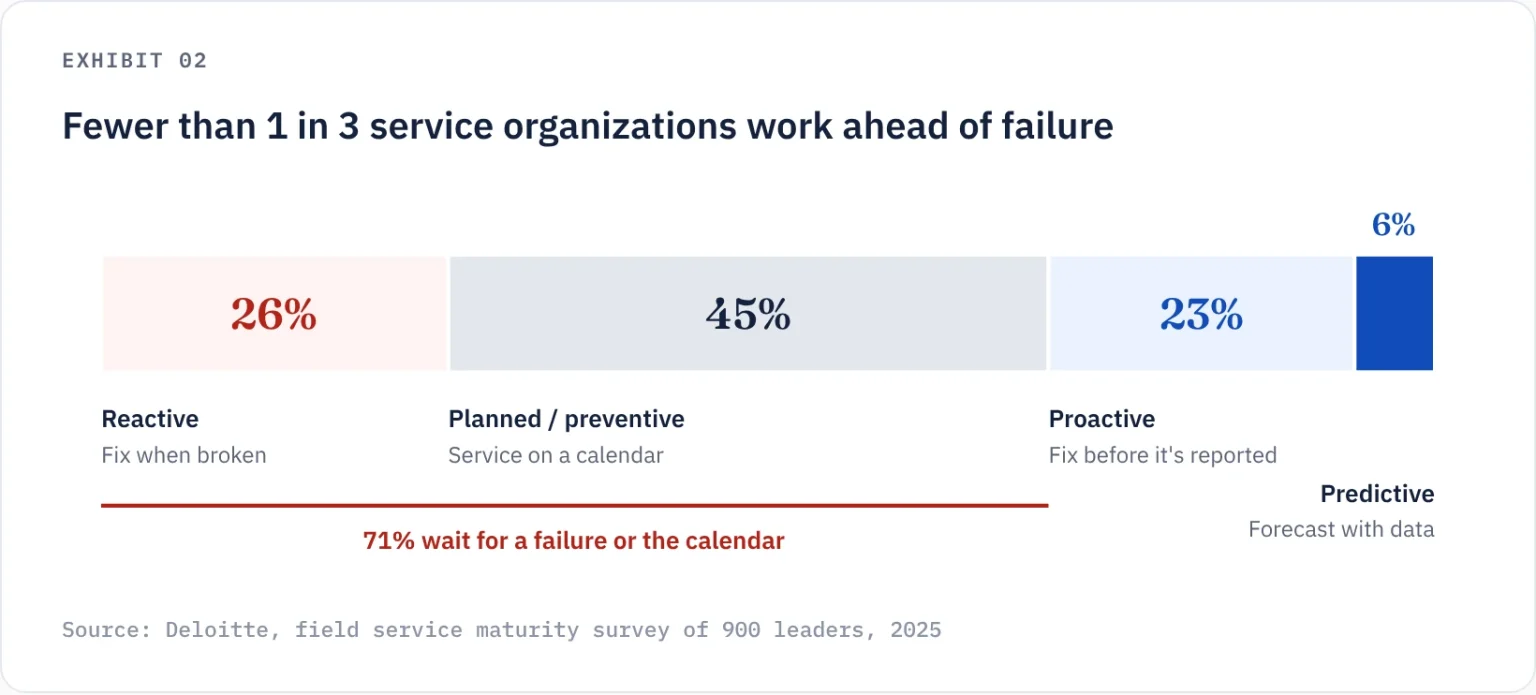
Calendar-based maintenance helps, but machines still fail between visits, and a visit report shows activity, not avoided downtime. The gap is costly: predictive maintenance saves 30 to 40 percent compared with reactive repair (U.S. DOE).
It also costs the contract. Service earns about 25 percent EBIT against about 10 percent for new equipment (McKinsey), so a 15 percent renewal discount can erase more than half a year's service margin on the account. Worse, customers with poor service experience churn faster (McKinsey), and independent service providers are waiting for the warranty to end.
Why reactive service can't produce proof
Most renewal advice says "show the value at the QBR." But a reactive record holds only failures and response times. You cannot prove value you did not create. Proof becomes possible only when service moves ahead of the failure.
Equipment operating data indicates an emerging performance issue. The service team identifies the risk, schedules an inspection, and addresses the problem during a planned maintenance window.
The customer avoids an unexpected interruption. And for the first time, there is something to show: a failure that did not happen, and production that was not lost.
Exhibit 03
The same bearing fault, handled three ways
| Reactive | Planned (calendar) | Proactive | |
|---|---|---|---|
| What happens | Machine fails mid-shift, fixed in 6 hours | Fails 5 weeks before the next scheduled visit | Fault flagged 3 weeks early, fixed in a planned shutdown |
| What you report | "Restored within SLA" | "12 PM visits completed" | "Failure prevented, no production lost" |
| What the customer remembers | A lost shift | A lost shift, despite the contract | Nothing went wrong |
| At renewal | Price negotiation | "What are we paying for?" | Proof of value, talk of the next tier |
Illustrative example
How do you prove the value of a service contract?
Preventing the failure creates the value. Making it visible is a separate step, because a prevented failure leaves no trace unless someone records it. Value survives procurement when it passes four tests.
Exhibit 04
Four tests that turn service data into proof
01
In the customer's own numbers
Their output per hour and their downtime cost, not an industry average.
02
Tied to a specific event
"Press 4, March 12, bearing replaced in a planned shutdown." Not "improved reliability."
03
Confirmed when it happens
The plant manager agrees to the number at the time, not for the first time at the QBR.
04
Visible all year
The customer watches value build month by month, not on one slide once a year.
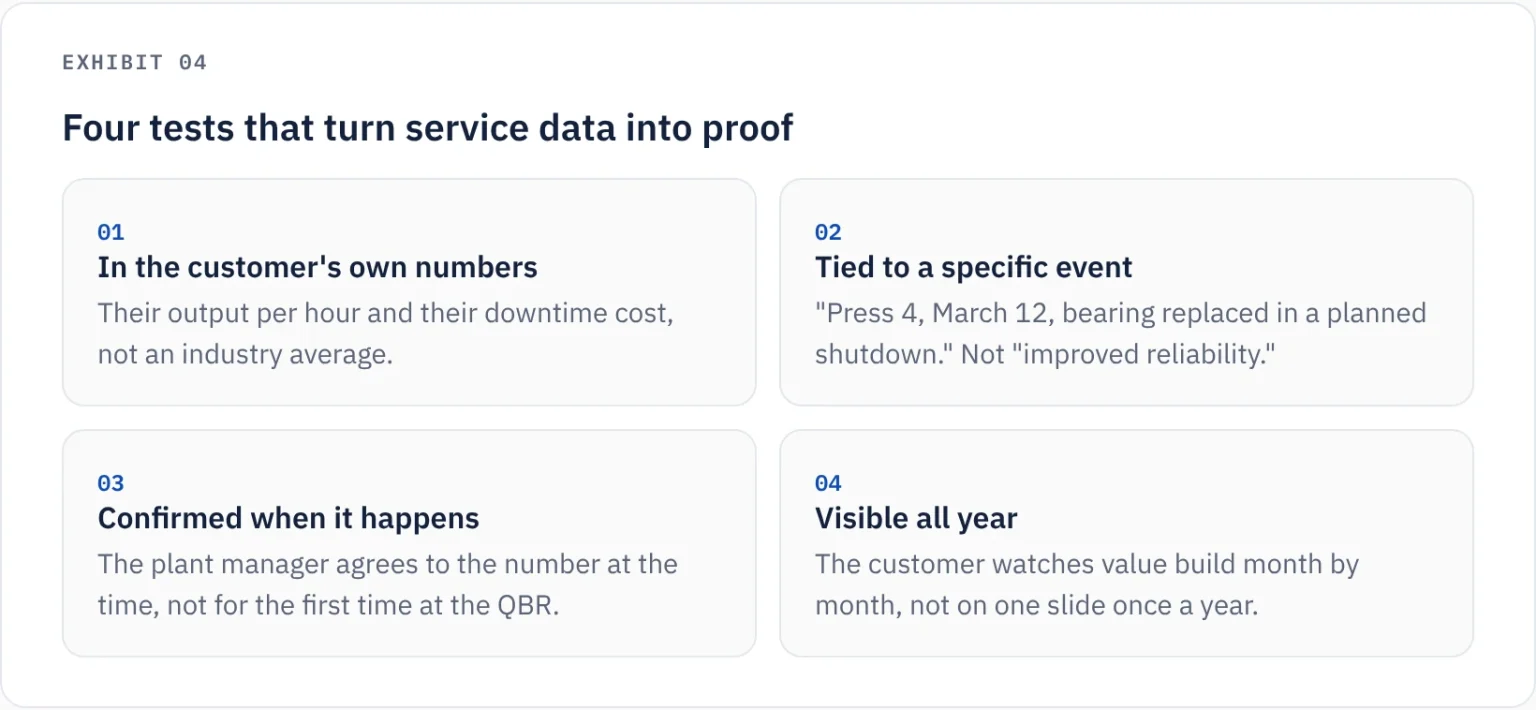
A $64,000 contract that prevented three line-down events, worth $118,000 of output at the customer's own rate and confirmed by their team, is not a cost to negotiate down. It has already paid for itself.
How to increase service contract renewals: work ahead of failure, all year
Renewals are rarely won in the 90 days before the meeting. They are won in the nine months before anyone mentions one.
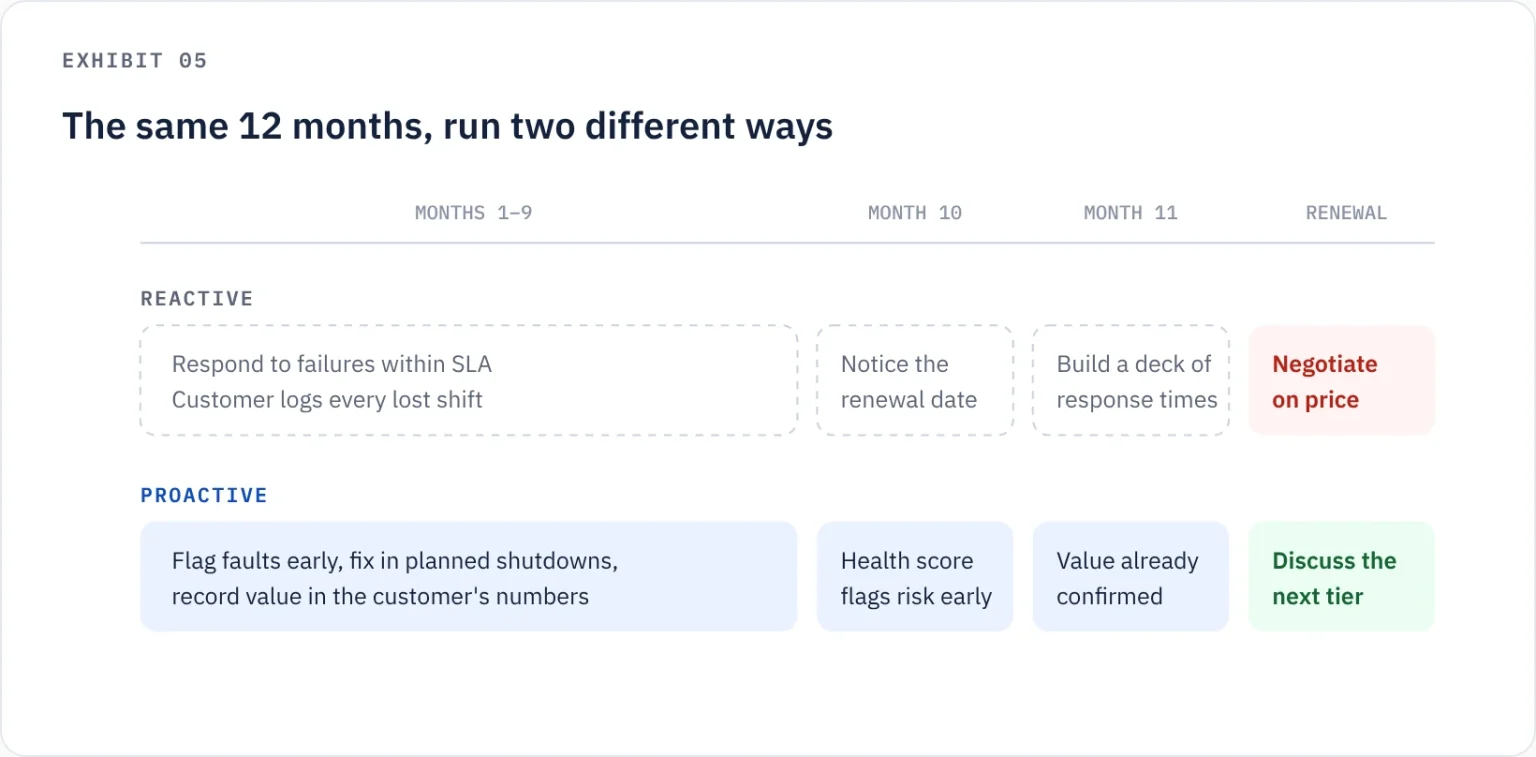
When service runs ahead of failure, the customer's downtime log gets shorter, every prevented failure becomes evidence, and the renewal conversation moves to the next tier instead of the next discount. We have seen it with our own OEM clients:
1 → 5 yrs
A one-year maintenance contract renewed as a five-year agreement once the customer could see prevented failures in their own numbers.
3.4×
Return on the service contract, measured in the customer's avoided repair costs and protected output.
Client-reported results from Gowitek OEM deployments.
Doing this by hand rarely survives a busy quarter. ServitizeIQflags emerging faults so your team can plan the fix, records each prevented failure in the customer's own terms, and shows your commercial team which accounts are healthy, at risk, or up for renewal. The renewal case builds while your team does the work.
The question worth asking before your next renewal
Over the last year, how many failures did your team respond to on your largest account, and how many did it prevent? If the first number is bigger, the renewal will be about price, however strong your SLA report looks.
See what your installed base could earn
In 30 minutes, we will show you the portfolio and renewal view, and estimate the recurring service revenue in your installed base.
Not ready to talk? Read the Service Margin Thesis →
Frequently asked questions
How do you increase service contract renewals?
Shift service from reactive repair to working ahead of failure, then make the value visible all year. Record each prevented failure in the customer's own numbers, have their team confirm it at the time, and track account health so at-risk customers surface while there is still time to act.
How do you prove the value of a maintenance contract?
Show outcomes the customer's finance team recognizes: failures prevented, downtime avoided, and output protected, valued at the customer's own rates and tied to specific, dated events. Response times and visit counts show activity, not value.
Why don't customers renew maintenance contracts?
Most often because the contract did not change their experience. With reactive service, the OEM can meet every SLA while the customer still loses production to each failure. By renewal, the contract looks like a cost rather than protection, and the customer negotiates hard or moves to a cheaper third-party provider.
Does meeting the SLA guarantee a renewal?
No. An SLA measures how quickly the OEM responds. The customer measures how much production they lost. A service team can meet every response target and still leave the customer with a downtime log that weakens confidence at renewal.
How do you stop discounting service renewals?
Put a confirmed value number next to the contract price. When procurement can see that a contract prevented more loss than it cost, measured in their own terms, the conversation shifts from price to coverage and next steps.